
Delivery-Ready Packaging: How to Make Products Arrive Perfectly (Across Seasons and Shipping Methods)
Shipping is where great products get tested. A bouquet can lose its shape in one sharp turn. Fresh fish can lose quality in minutes if temperature control slips. For procurement teams and operations managers, “delivery-ready” packaging isn’t just a cost line — it’s insurance against complaints, waste, and reputation damage.
This guide breaks down practical rules for courier shipping and self-pickup, explains what changes in summer vs. winter, and shows two real-world packaging logics: protecting delicate, shape-sensitive goods (flowers) and temperature- and odor-sensitive goods (fish).
1) Start With the Delivery Risk Map (Before You Choose Materials)
Before selecting packaging, define the risk profile of your product and route:
- Mechanical stress: compression, vibration, drops, stacking pressure
- Moisture & condensation: humidity, meltwater, rain, cold-to-warm transitions
- Temperature exposure: heat spikes, freezing risk, time outside cold chain
- Leaks & odor migration: especially critical for seafood and marinated products
- Time in transit: same-city delivery vs. regional distribution vs. export
Procurement tip: Ask suppliers for packaging solutions by risk category, not only by product category. It speeds up testing and reduces overpackaging.
2) Use the “3-Layer System” for Reliable Transport
The most consistent delivery results come from designing packaging in layers:
Primary layer (product contact)
- Hygiene, direct protection, barrier properties (where needed)
Secondary layer (structure + stability)
- Holds shape, prevents crushing, secures the item inside
Tertiary layer (transport handling)
- Boxes, crates, insulation, labels, and tamper evidence for logistics
This approach works equally well for premium bouquets and frozen seafood — the difference is which performance traits each layer must prioritize.
3) Courier vs. Self-Pickup: Packaging Rules Change
For courier delivery
You need packaging that survives:
- Sorting hubs and conveyor handling
- Unknown stacking loads
- Delays and extra stops
- Vehicle temperature swings
Best practice: Standardize shipping formats (2–3 box sizes, consistent internal supports). This reduces packing errors and speeds up training.
For self-pickup
You can reduce tertiary packaging, but you still need:
- Comfortable carrying (handles, grips, rigidity)
- Clean outer surfaces (no leaks, no staining)
- Protection against weather at the storefront exit
Best practice: Offer an “upgrade layer” (e.g., a protective sleeve or outer bag) for rainy days and long walks.
4) Seasonal Packaging Strategy: Summer vs. Winter
Summer (heat, humidity, odor volatility)
- Prioritize temperature management for food
- Expect softening adhesives, more condensation, and faster spoilage risk
- For flowers, heat accelerates wilting and petal damage
Key moves:
- Insulation + cold packs (food), breathable protection (flowers)
- Higher leak resistance and odor barriers (seafood)
- Avoid trapping heat in direct sunlight (last-mile deliveries)
Winter (freezing, brittle materials, condensation on warming)
- Materials can become stiffer and more brittle
- Condensation appears when cold products enter warm environments
- For fish: freezing can be good (if planned), destructive (if accidental partial-freeze/thaw)
Key moves:
- Choose films/papers that keep performance in low temps
- Add protective outer layers against snow/rain
- Plan for condensation: absorbent inserts, secondary containment
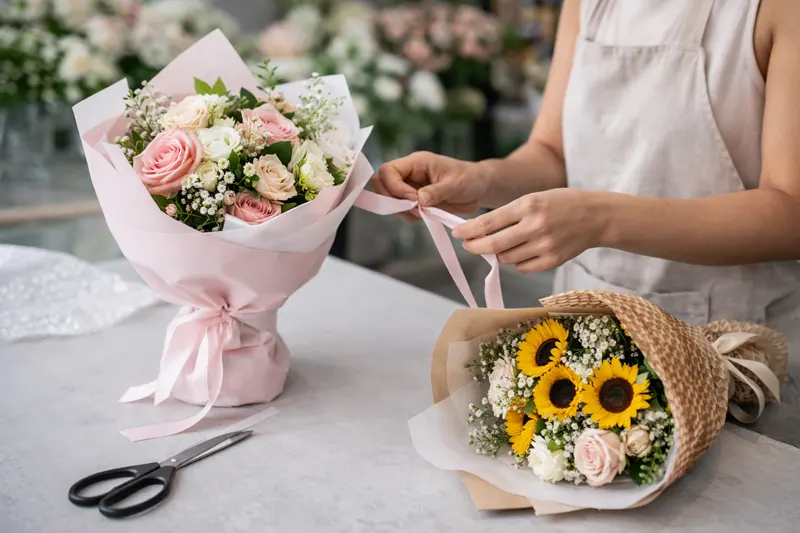
5) Case 1: Delicate Goods (Flowers) — Prevent Crushing, Keep Shape, Secure Moisture
Flowers are “fragile architecture.” The goal is to protect structure without suffocating the bouquet.
What flower shipping packaging must do
- Resist compression while staying lightweight
- Prevent petal scuffing and stem movement
- Manage moisture (keep stems hydrated without soaking outer wrap)
- Present beautifully on arrival (wrinkles and dents look like poor quality)
Practical packaging tactics for bouquets
- Structural wraps that hold form (supporting sleeves / shaped wraps)
- Soft inner layers to prevent abrasion and keep a premium feel
- Stem stabilization (to stop the bouquet from “sliding” in transit)
- Water protection: secure hydration solutions to avoid leaks into outer layers
If you’re sourcing wraps, papers, and presentation layers for floristry, explore dedicated options under Flower Wrapping.
6) Case 2: Sensitive Foods (Fish) — Control Temperature, Leaks, and Odor
Seafood packaging is judged on one thing: confidence. If the pack smells, leaks, or arrives warm, trust is gone.
What fish shipping packaging must do
- Maintain cold chain performance as long as possible
- Prevent leaks (meltwater, juices)
- Reduce odor migration to outer packaging and other parcels
- Protect texture (avoid dehydration, freezer burn, and repeated temperature swings)
Practical packaging tactics for fish
- High-barrier primary packaging (to protect freshness and reduce oxidation)
- Secondary containment (a second sealed layer to catch leaks)
- Insulated tertiary packaging for chilled/frozen transport
- Clear labeling: “Keep Refrigerated/Frozen,” “This Side Up,” handling instructions
For specialized solutions aimed at freshness, freezing, and transport resilience, see Fish Packaging.
7) Quality Control Checklist for Procurement and Operations
Use this checklist to evaluate packaging before committing to volume закупівель:
- Drop & vibration tolerance: does the pack maintain form and seals after handling?
- Leak testing: can it withstand tilt, pressure, meltwater exposure?
- Temperature performance: how long does it hold target range with your route profile?
- Condensation behavior: does moisture damage presentation layers or labels?
- Line compatibility: speed of packing, sealing reliability, error rate
- Unboxing experience: does it look and feel “as promised” on delivery?
Procurement tip: Request sample runs and test packs in real routes (summer + winter). Lab specs matter, but field performance wins.
8) Reduce Returns Without Overpackaging
Overpackaging often happens when teams try to “solve everything with more material.” A smarter approach is to match materials to the top risk:
- For flowers: invest in shape control and surface protection
- For fish: invest in barrier + containment + insulation, then optimize outer layers
- Standardize processes, not just materials: packing steps matter as much as the pack itself
Conclusion: Delivery-Ready Packaging Is a System, Not a Single Material
Perfect arrivals come from aligning packaging layers with real delivery risks — mechanical stress, moisture, temperature swings, and handling uncertainty. Flowers and fish sit at opposite ends of the spectrum, but they teach the same lesson: when packaging is engineered for the route (not just the product), quality survives the journey.


Leave a Reply
Want to join the discussion?Feel free to contribute!